What Is 7-OH?
An evidence-focused explainer on 7-hydroxymitragynine, potency, product forms, and regulatory concern.
Updated
6 sources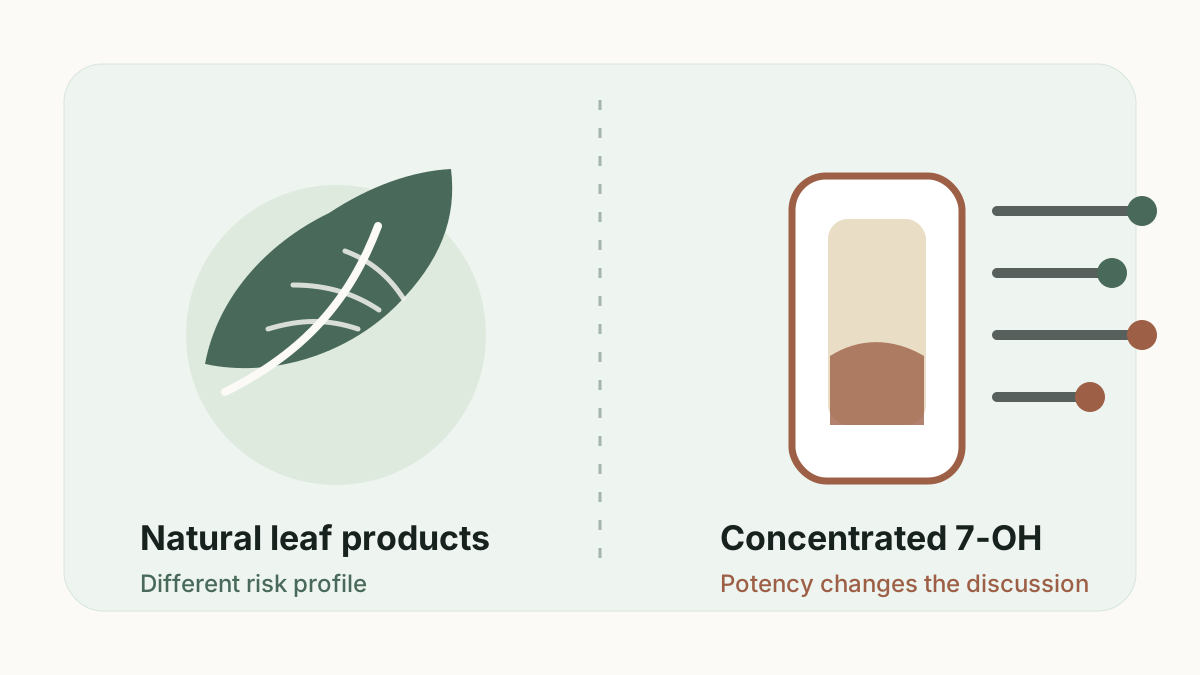
Direct answer
7-OH means 7-hydroxymitragynine, a kratom-related compound that activates mu-opioid receptors. Concentrated 7-OH products are not equivalent to natural leaf. Kruegel et al. 2016 receptor study explains the receptor activity; FDA letter to health care professionals distinguishes trace leaf content from concentrated products.
What is in a 7-OH product?
Ask about the substance, not just the word "kratom" on the package. FDA identifies tablets, gummies, drink mixes, and shots, and warns that labels can obscure 7-OH content. Store availability is not evidence of medical approval. FDA July 2025 scheduling recommendation
Natural leaf, an extract, and a product intentionally enhanced with 7-OH should be evaluated separately. FDA reports less than 2% 7-OH as a share of natural leaf's total alkaloids, not as a share of leaf weight. Do not compare that figure directly with milligrams per tablet or a finished-product percentage. FDA 7-OH scientific assessment
Does natural mean safe?
A compound's plant origin does not establish the safety of a concentrated formulation. FDA describes chemical conversion of mitragynine as a likely source of enhanced 7-OH; that does not establish how every individual product was made. FDA 7-OH scientific assessment
The practical question is what exposure the product delivers. A familiar brand, a small package, or a botanical label cannot answer that question.
What does potency mean?
Potency describes how much of a substance is needed to produce a particular effect in a particular test. It is not the same as the maximum effect or the probability of harm. Receptor binding, tissue assays, animal behavior, and human outcomes answer different questions.
Kruegel and colleagues found mu-opioid receptor activation in laboratory experiments. That supports an opioid mechanism, not a safe consumer dose or a morphine-to-7-OH conversion. Kruegel et al. 2016 receptor study
Why dependence and breathing matter
FDA's clinician warning identifies addiction, withdrawal, insomnia, anxiety, seizures, and potentially fatal respiratory depression. These are reasons to seek care, not a prediction that every exposure will have the same outcome. FDA letter to health care professionals
Read Signs of Dependence and Withdrawal for patterns to discuss with a clinician, and Get Help for emergency and treatment resources.
What changed in October 2026?
FDA's updated page describes a threshold approach intended to distinguish concentrated 7-OH and mitragynine pseudoindoxyl (MGPI) products from botanical profiles. FDA October 2026 7-OH update
The October 14 notice is a notice of intent, not an effective 7-OH scheduling order. It says an order may be published on or after November 13, 2026. DEA October 14, 2026 notice of intent See the Regulatory Tracker for the proposal's scope and existing MGPI controls.