Why Some Call 7-OH Products Gas Station Heroin
A careful explanation of the phrase, the product forms behind it, and where the phrase can mislead.
Updated
3 sources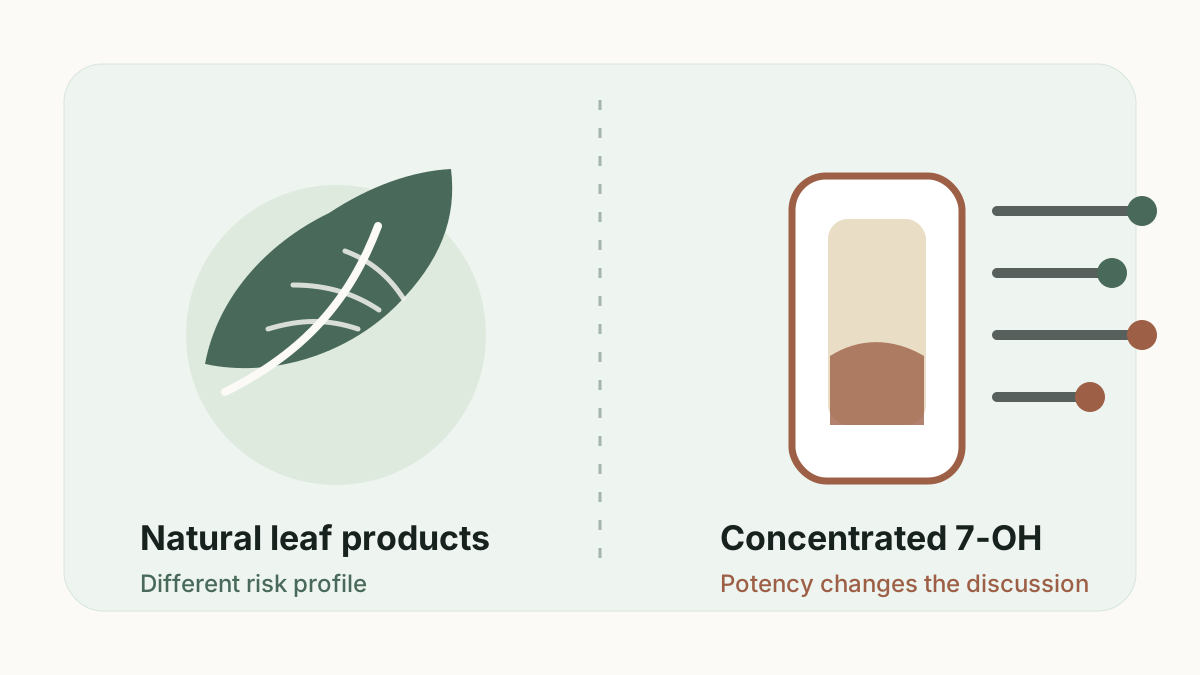
Direct answer
"Gas station heroin" is a slang label, not a chemical identity or a diagnosis. For this guide, the relevant category is concentrated 7-OH products: FDA describes their retail availability and opioid-related risks. FDA July 2025 scheduling recommendation
What is behind the phrase?
FDA identifies products sold online and in ordinary retail settings, including gas stations and vape shops. It also warns about flavored products and unclear labeling. Those concerns should be described directly rather than relying on a nickname. FDA July 2025 scheduling recommendation
Why opioid language is relevant
7-OH activates mu-opioid receptors in laboratory studies. That makes opioid pharmacology relevant; it does not mean 7-OH is heroin or that the substances have equivalent doses. Kruegel et al. 2016 receptor study
FDA's clinician letter warns about addiction and potentially fatal respiratory depression with concentrated 7-OH. The warning deserves attention without sensational comparisons. FDA letter to health care professionals
What should I ask about a package?
Look for the full ingredient names, labeled amounts, serving size, and terms such as "enhanced" or "spiked." Photograph the label before a clinician visit. Do not infer contents from a slang name, flavor, store type, or the word "natural."
If the label is unclear, record that uncertainty. Do not fill the gap with an assumed dose or composition.
Better language for reporting and family conversations
Name the product and compound when known: "a concentrated 7-OH tablet" is more informative than "gas station heroin." Keep natural leaf, extracts, and intentionally enhanced products distinct.
Read What Is 7-OH? for the compound and product distinction, or Get Help if there is an immediate concern.